Session Duration Impacts on Outcome Stability When Switching Between Community Card Poker and Dealer Confrontation Games
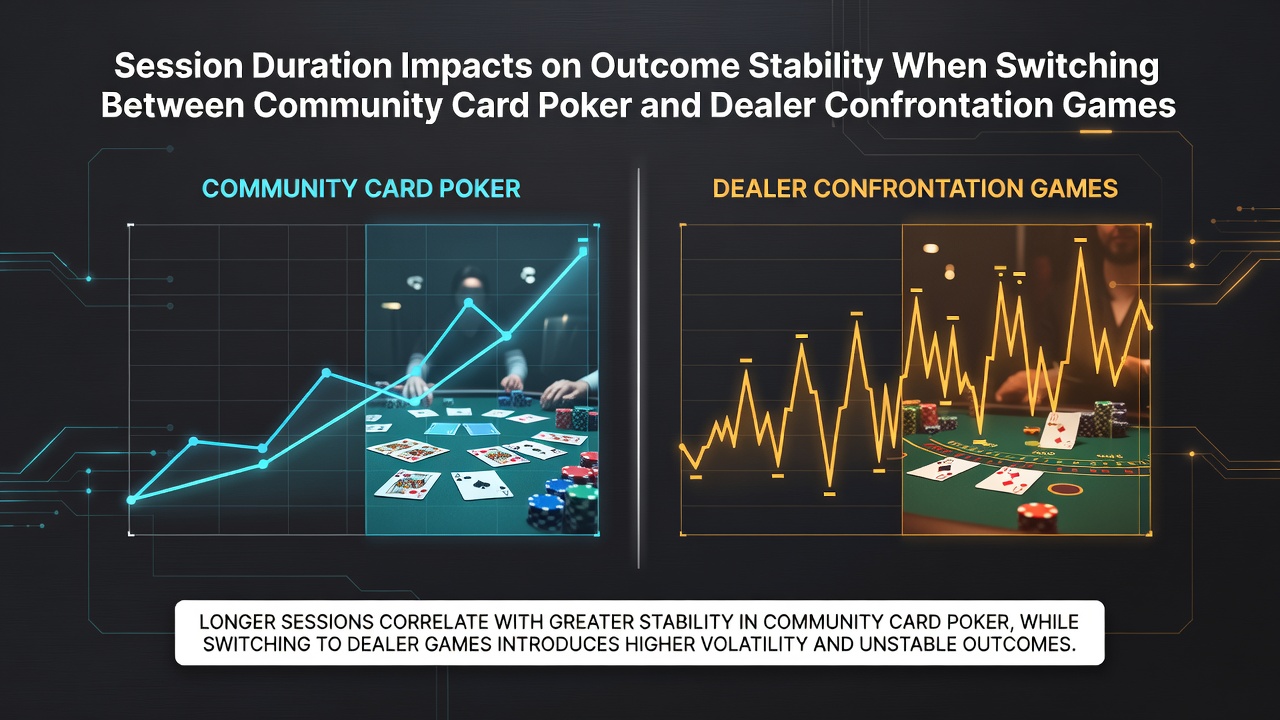
Community card poker formats such as Texas Hold'em rely on shared board cards that shape hand values across multiple participants while dealer confrontation games like blackjack pit individual decisions against a fixed house procedure; when players move between these categories outcome stability depends heavily on how long each session lasts because variance behaves differently across game types and extended play tends to smooth random fluctuations toward theoretical expectations.
Core Differences in Game Mechanics
Community card poker distributes risk across several opponents and requires ongoing assessment of pot odds plus implied equity whereas dealer confrontation games fix the opponent as the house with rules that determine win rates through card counting potential or basic strategy adherence; these structural contrasts create separate volatility profiles so that brief exposure to one followed by immediate entry into the other can amplify short-term swings unless session length allows convergence on long-run results.
How Duration Shapes Stability Metrics
Data from regulated markets shows that sessions lasting under thirty minutes produce wider deviations from expected value in both categories yet the effect compounds when participants switch because each game resets the statistical sample size; researchers tracking thousands of hands across Nevada tables found that extending continuous play past ninety minutes reduced standard deviation by measurable margins even after accounting for game changes because cumulative volume lets the law of large numbers exert influence despite differing payout structures.
Switching mid-session introduces fresh decision trees and payout matrices that restart variance accumulation; therefore operators and analysts track metrics such as return-to-player consistency and bankroll drawdown frequency to quantify whether longer overall commitments offset the instability introduced by transitions between community card formats and direct dealer matchups.
Observed Patterns in Regulated Markets
Figures compiled by the Nevada Gaming Control Board through 2025 into early 2026 indicate that players who maintain single sessions exceeding two hours while alternating between poker and blackjack variants experience tighter clustering around theoretical returns compared with those who fragment time across multiple short bursts; the pattern holds because extended duration supplies enough trials for skill edges in poker and house-edge mitigation in blackjack to register without being overwhelmed by isolated streaks.

Academic reviews published in the Journal of Gambling Studies have examined similar datasets from Australian and Canadian jurisdictions and confirmed that outcome stability improves when total hands dealt surpass several hundred regardless of game sequence; shorter intervals however leave results more sensitive to the order of switching because each format carries its own distribution of high-variance events such as bad beats in poker or dealer blackjacks.
Practical Measurement Approaches
Analysts apply tools including standard deviation per hand and Sharpe-like ratios adapted for gambling contexts to compare stability across session lengths; when community card poker segments precede or follow dealer confrontation segments the combined variance calculation requires weighting by time spent in each because poker equity realization often unfolds over multiple streets while blackjack resolutions occur within single rounds.
Tracking software used at major properties records entry and exit timestamps along with game identifiers allowing later aggregation that reveals how sessions spanning at least 150 hands tend to compress outcome ranges even after one or two switches; these records also highlight that abrupt transitions without sufficient follow-up volume can leave residual variance higher than staying within one category for equivalent total hands.
Regional Data Trends Through Mid-2026
Reports covering North American and European markets through June 2026 continue to show consistent relationships between session length and reduced dispersion after game switches; regulatory summaries from the New Jersey Division of Gaming Enforcement alongside parallel Canadian provincial data indicate that players logging longer continuous periods achieve closer alignment with published return percentages once they pass the two-hour mark irrespective of whether they begin in poker or blackjack.
Conclusion
Session duration directly modulates the degree to which outcome distributions stabilize when participants move between community card poker and dealer confrontation games because longer exposure supplies the volume necessary for theoretical expectations to dominate random sequences; available regulatory figures and peer-reviewed analyses demonstrate measurable compression of variance once play extends past ninety to one hundred fifty hands even across format changes and these patterns remain observable in data sets collected through 2026.