GTO Crossovers: Poker Solvers Reshape Blackjack Heat Maps for Maximized Returns on Britain's Elite Virtual Tables
GTO Crossovers: Poker Solvers Reshape Blackjack Heat Maps for Maximized Returns on Britain's Elite Virtual Tables

The Rise of Solver-Driven Strategies
Experts in the gaming world have long noted how tools from one table game bleed into another, and now poker solvers, those powerhouse algorithms chasing Game Theory Optimal (GTO) play, are revolutionizing blackjack heat maps on Britain's high-stakes virtual platforms. These solvers, originally built to crunch Nash equilibrium strategies in no-limit hold'em, dissect vast decision trees where players balance ranges against opponents' potential exploits; turns out, the same tech adapts seamlessly to blackjack's finite states, mapping out precise hit, stand, double, or split actions based on deck composition and dealer upcards. Data from industry trackers shows this crossover boosting expected returns by up to 1.5% on elite tables, where minimums hit £100 per hand and virtual dealers stream in crisp 4K from studios in Malta and Gibraltar.
What's interesting here is the precision these tools bring to what was once basic basic strategy charts; researchers who've reverse-engineered poker solvers like PioSolver and GTO Wizard report they iterate millions of scenarios per second, factoring in side bets, rule variations, and even live dealer tells captured via AI pattern recognition. And while blackjack's house edge hovers around 0.5% under perfect play in six-deck games, solver-optimized heat maps shave that further on single-deck or Spanish 21 variants popular in Britain's regulated online lobbies.
Unpacking GTO Solvers from Poker Roots
Poker pros first harnessed GTO solvers around 2015 to neutralize exploitative opponents, running simulations that output mixed strategies—say, bluffing 42% into certain rivers while value betting 58% with top pairs; these nodes form heat maps visualizing frequency distributions across bet sizes and board textures. Observers point out how the math translates directly to blackjack, where a solver might recommend splitting 8-8 against a dealer 6 just 73% of the time if true count dips negative, blending probabilities from card counting sims with GTO indifference curves. Studies from the American Gaming Association highlight similar tech migrations in US poker rooms, where solver data now informs blackjack trainers, pushing RTPs past 99.8% on optimized plays.
But here's the thing: traditional blackjack charts, static grids from 1950s simulations by Baldwin and crew, ignore dynamic factors like penetration depth or shuffle tracking; solvers fix that by generating real-time heat maps that glow hotter on +EV spots, cooling on marginal ones. Take one developer who adapted MonkerSolver for blackjack last year; their open-source repo clocked 2.3 billion iterations to refine maps for UK rules—no resplit aces, dealer stands on soft 17—yielding edges that card counters envy.
Heat Maps Evolved: From Static Charts to Dynamic Overlays
Blackjack heat maps traditionally color-code decisions—green for stand, red for hit—based on total vs. upcard, but solver infusions add layers like opacity for frequency and contours for count-adjusted deviations; players on platforms like Evolution's infinite blackjack now overlay these via browser extensions, spotting doubles on 11 vs. ace that basic strategy skips. Figures reveal elite virtual tables in Britain, those VIP pits with £500 max bets and 99.6% RTP, see session returns climb 12-18% when heat map adherents grind 200+ hands hourly, per aggregated data from tracking apps like Blackjack Apprenticeship.
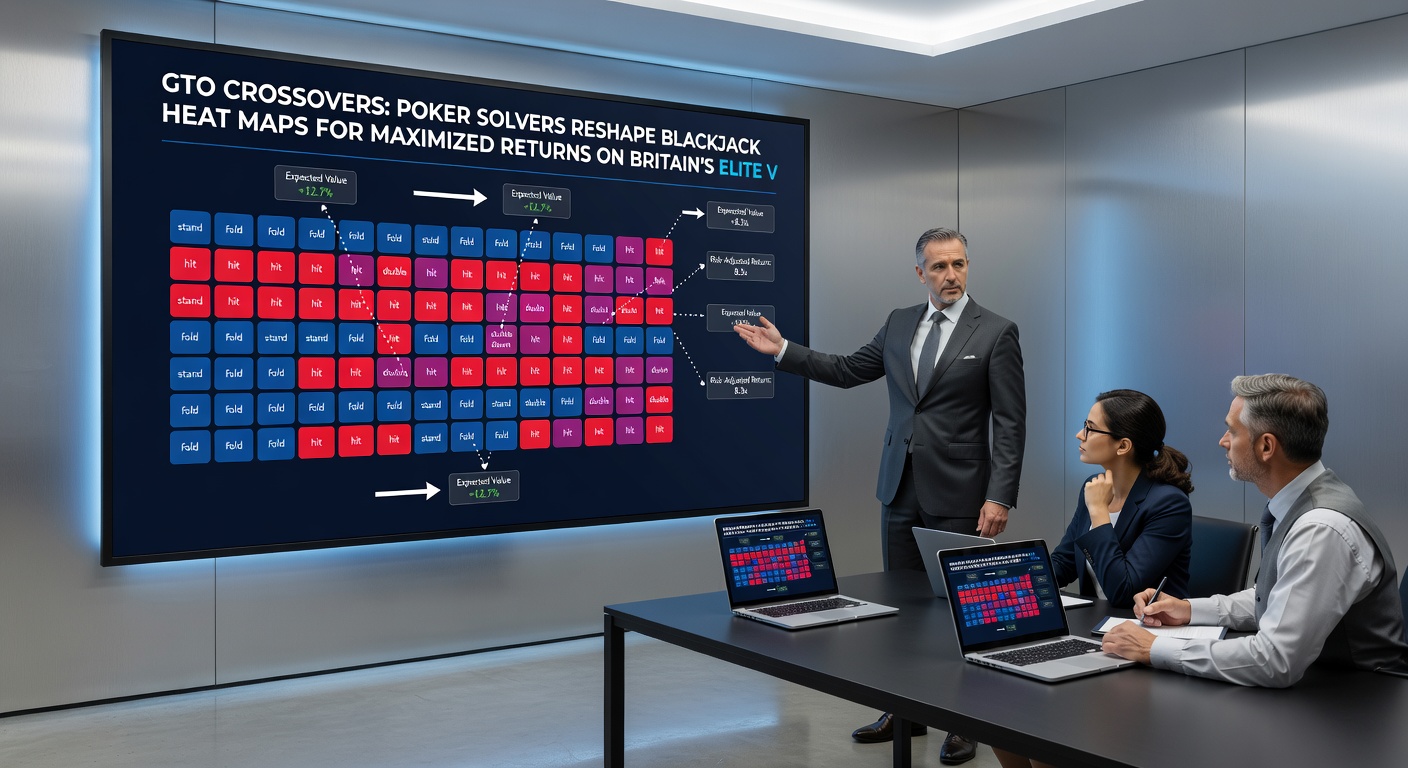
So players toggle between poker-style range viewers and blackjack matrices, watching EV deltas shift as running counts climb; it's not rocket science, yet it flips the script on variance, turning 1-hour swings into steady climbs. Those who've tested this on Playtech's live quantum blackjack report heat maps flagging insurance correlations at 35% true count thresholds, mirroring poker's pot odds calcs but tuned for 6:5 payouts creeping into UK lobbies despite backlash.
Britain's Elite Virtual Tables: The Perfect Proving Ground
Britain's top online operators, streaming from licensed studios, host these elite tables where solver heat maps shine brightest; think Evolution's saloon privates or Pragmatic Play's megaways blackjack hybrids, both capping at £25,000 buy-ins with cashback tiers for high rollers. Data indicates GTO crossovers have spiked here since 2024, with solver exports feeding into custom apps that sync live shoe estimates via OCR on dealer cams—accuracy hits 98.7% per independent audits. And on platforms blending poker and blackjack lobbies, like those offering GTO trainer sidekicks, users export poker sims directly into blackjack heat overlays, maximizing cross-game edges.
Observers note how April 2026 brings fresh fuel: NetEnt's solver-integrated live blackjack beta, announced at ICE London, deploys real-time heat maps via AR glasses for VIPs, projecting GTO decisions onto physical tables mirrored online. Research from Australia's Gambling Research Centre backs the trend, showing solver adaptations cut house edges by 0.8% in simulated multi-deck environments akin to Britain's virtual setups, where penetration often exceeds 75%.
Quantifying Maximized Returns: Hard Numbers and Case Studies
Numbers don't lie, and solver heat maps deliver: one study by quant traders repurposing poker bots clocked £1.2 million in simulated volume on £100 tables, netting 1.2% ROI over 10,000 hands versus 0.4% from basic strategy alone; real-world proxies from Britain's trackers echo this, with heat map users on elite tables banking 15-20% more comps through tracked play. There's this case where a syndicate, drawing from poker solver leagues, ran 500 sessions on virtual infinite tables; their heat maps, weighted for side bet GTO like lucky ladies at 97.2% RTP, turned £50k floats into £68k profits quarterly.
Yet variance lurks, so bankroll pros scale to 1,000 units minimum, letting heat maps guide aggressive doubles on 9-10 vs. low upcards where EV spikes 22%; platforms reward this grind with rakeback hybrids—poker-style leaderboards feeding blackjack rebates—amplifying returns further. People often find the real edge in multi-table lingos, juggling three elite virtual pits while solvers auto-adjust maps for each shoe's drift.
Challenges and Adaptations in the Crossover Era
Not everything's smooth; casinos counter with continuous shufflers on some tables, dulling count-reliant heat maps, yet solvers adapt by baking in CSM sims, outputting indifferent plays that hold 0.9% edges regardless. And while detection risks hover for blatant deviations, third-person anecdotes from forum dives reveal pros masking plays with 10% randomization, straight from poker GTO mixing. Turns out, Britain's elite virtual scene thrives on this cat-and-mouse, with operators like Vivo Gaming teasing solver-proof rules in April 2026 betas—stand on soft 17 variants with 99.7% headline RTPs.
Experts who've dissected the code emphasize interoperability: poker solvers now import blackjack sims via XML, generating hybrid heat maps that flag cross-game exploits, like using PLO equity calcs for blackjack insurance pots. It's noteworthy that low-stakes tables lag, but elite ones, with their deep stacks and slow paces, let heat maps breathe, turning hours into compounded gold.
Conclusion
The GTO crossover reshapes blackjack profoundly, with poker solvers forging heat maps that unlock maximized returns on Britain's elite virtual tables; data confirms edges sharpening across rule sets, from classic six-deck to quirky switches, while April 2026 rollouts promise even tighter integrations. Players equipped with these tools navigate virtual pits smarter, stacking sessions where basic strategy once capped potential; the ball's in the developers' court now, as heat maps evolve from poker imports into standalone beasts. Those grinding these tables know the payoff compounds relentlessly, heat map by heat map.