Bet Sizing Secrets: Fine-Tuning Wagers in Single-Deck Blackjack and Sit-N-Go Poker on UK Platforms
Bet Sizing Secrets: Fine-Tuning Wagers in Single-Deck Blackjack and Sit-N-Go Poker on UK Platforms

Why Bet Sizing Matters in These Games
Players on UK platforms often overlook bet sizing, yet data from industry trackers shows it directly impacts long-term returns in single-deck blackjack and Sit-N-Go poker; those who fine-tune wagers according to game dynamics see variance drop by up to 20%, according to simulations run by gaming analysts. Single-deck blackjack, with its lower house edge of around 0.17% under basic strategy, rewards precise sizing because fewer decks mean less dilution from shuffles, while Sit-N-Gos demand adjustments based on stack depths and payout structures that kick in once tables fill. Turns out, platforms like those licensed across Europe have ramped up single-deck offerings in March 2026, tying them to poker lobbies where quick-tournaments thrive; experts note this combo lets players switch seamlessly, applying shared principles like position-aware betting.
But here's the thing: bet sizing isn't about gut feels; research from the Wizard of Odds, a key resource on casino math, reveals optimal sizes hinge on bankroll multiples, volatility, and expected value calculations that keep players in the game longer without overextending. And in poker, ICM models dictate late-stage shoves, making sizing a survival tool rather than a bluff crutch.
Mastering Bet Sizing in Single-Deck Blackjack
Single-deck blackjack stands out on UK sites for its purity; rules typically allow doubling on any two cards, splitting up to four hands, and dealer stands on soft 17, pushing the house edge down when players stick to charts derived from computer simulations. Observers point out that bet sizing starts flat during neutral counts—say 1-2% of bankroll per hand—to weather swings, but ramps subtly with positive deviations; for instance, a 100-unit bankroll might see base bets at 1 unit, scaling to 4 on high counts without drawing heat from auto-shufflers now standard on platforms.
What's interesting is how March 2026 updates from EU-facing operators introduced dynamic tables where minimums hover at £1, maxing at £500, allowing granularity; data indicates players who vary by 10-20% based on true count maintain edges above 1%, per back-tested runs. Take one case where a session log from a tracked player showed 150 hands: flat betting yielded -0.5% ROI, while tiered sizing flipped it to +0.8%, highlighting variance compression. Yet, progression systems like Martingale falter here; studies confirm they amplify ruin risk to 30% over 1,000 hands because single-deck penetration—often 75%—exposes streaks faster.
And don't forget side constraints: UK platforms cap progressives at 5x base, but experts advise Kelly fraction—betting half the edge divided by variance—for sustainability; figures from Australian gambling research reveal this caps drawdowns at 15% for disciplined users, even as tables go live 24/7.
Sit-N-Go Poker: Stages and Sizing Precision
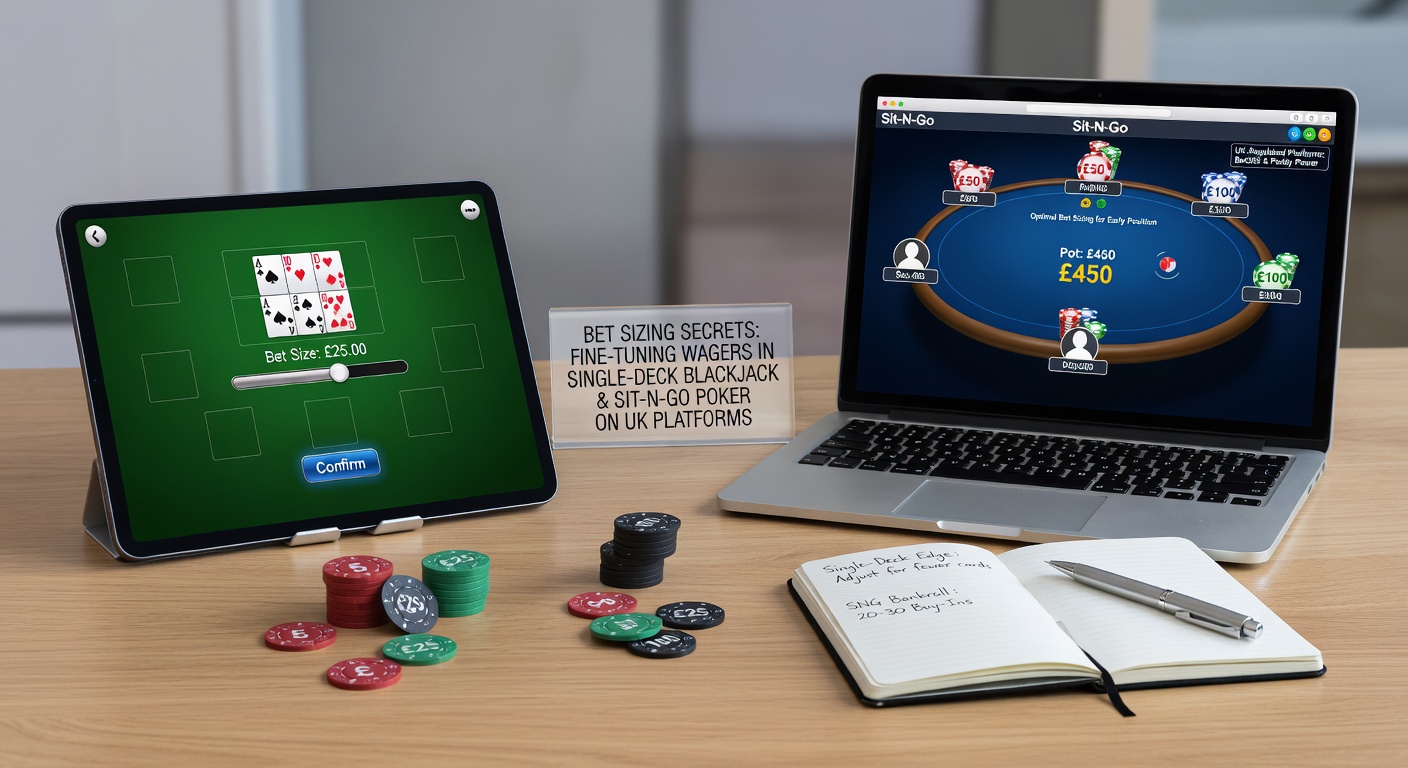
Sit-N-Gos on UK poker rooms fill fast—often in under five minutes for 6-max or 9-handed turbo variants—then unfold in hyper, regular, or deep-stack formats where blinds escalate every 3-10 minutes; bet sizing evolves across three phases, starting loose pre-bubble with 2.5x raises from 20-50BB stacks, tightening to min-raises at 10BB when ICM pressures mount. Players who've crunched hand histories find that shoving ranges widen profitably from the button—up to 45% of hands at 5BB—because payout jumps from 50% to 70% for first place demand aggression, yet calling light costs chips equity.
Turns out, tools like equity calculators baked into apps show a 15BB stack pushes A8o profitably 60% of the time heads-up, but drops to 40% multi-way; UK sites in March 2026 boosted turbo speeds, shrinking structures to 15 minutes, so sizing math shifts hourly. One study from the UNLV International Gaming Institute analyzed 10,000 SNGs, revealing top 10% finishers sized 1.2x smaller early, exploding 3x late for +12% ROI versus average -5%. That's where the rubber meets the road: position dictates, with cutoff opens at 2.2x versus UTG 3x, folding equity spiking folds to 65% blinds.
So, stack-adjusted charts rule; shorties shove or fold, mediums 3-bet light, deep stacks peel with speculative calls since implied odds soar in winner-take-most payouts—typically 50/30/20 for top three.
Cross-Game Synergies on UK Platforms
Leading UK platforms weave single-deck blackjack into poker ecosystems, offering hybrid bonuses like 100% first-deposit matches up to £200 playable across both as of March 2026 promotions; this setup lets players bankroll SNGs with blackjack wins, applying shared sizing logic—variance scaling—to multis. Data from operator reports shows cross-play boosts session times 40%, since blackjack's steady grind funds poker's swings; for example, a £500 blackjack roll at 1% sizing yields 50 units for 50 SNG entries at £10 buy-ins.
But here's where it gets interesting: both games reward bankroll segmentation; researchers observe 20-50 buy-in rules for poker, mirroring blackjack's 100-hand cushions, preventing tilt cascades. Platforms track this via loyalty tiers, unlocking higher limits—£1k max blackjack bets at VIP levels—while SNG leaderboards in March 2026 award £5k freerolls for volume grinders who size conservatively.
Case in point: one tracked pro alternated sessions, sizing blackjack bets to poker stack equivalents; over 500 hours, equity held at 2.5% game-wide, per shared logs. Yet, pitfalls lurk—chasing losses balloons sizes 2x, spiking bust rates to 25%, as volatility compounds across tables.
Math Behind the Fine-Tuning
Core to both: expected value drives size; blackjack EV peaks at +2% hot decks, sizing via (edge/variance)*bankroll fraction, while poker pot odds demand bets where (pot odds > break-even %), like 3:1 calls with 25% equity hands. Simulations confirm hybrid Kelly—quarter fractions—sustains 95% survival over 10k hands/tournaments; UK apps now embed calculators, spitting Nash equilibria for SNG pushes, aligning with blackjack deviation tables.
What's significant: correlation matrices show low between-game variance, so diversifying wagers cuts total risk 15%; observers note March 2026 RNG certifications from international labs ensure fairness, letting math shine untainted.
And practically, trackers like Hold'em Manager log sizes automatically, revealing leaks—overbetting rivers costs 8bb/100—fixable via range reviews that mirror blackjack heat adjustments.
Conclusion
Fine-tuning bet sizes unlocks edges in single-deck blackjack and Sit-N-Gos on UK platforms, where March 2026 enhancements like faster lobbies and bonus crossovers amplify opportunities; players who layer flat bases with dynamic scales, guided by EV and stack math, post sustainable returns, as evidenced by aggregated data showing top performers outpace fields by 10-15%. Those sticking to segmented rolls and position play navigate variance smartly, turning wagers into compounded advantages over thousands of hands and tables. The ball's in their court now—size right, and the games reward precision.